How to Boost SEO Rankings: The Ultimate Step-by-Step Blueprint for Search Dominance
Executive Summary & Modern Search Engine Optimization (AEO / GEO / AIO) Overview
Search Engine Optimization has underwent a fundamental transformation. Search engines are no longer simple keyword-matching scripts; they are sophisticated, AI-driven answer engines designed to deliver direct, accurate, and deeply authoritative answers. To achieve top rankings in Google’s Search Engine Results Pages (SERPs) and secure prime real estate across AI Overviews, Answer Engine Optimization (AEO), Generative Engine Optimization (GEO), and Artificial Intelligence Optimization (AIO), your website must offer unmatched depth, flawless technical execution, and user-first value.
To learn how to boost seo rankings, website owners, digital marketers, and agency founders must systematically optimize every layer of their digital infrastructure. This master guide provides an exhaustive, 6,000+ word strategy for website owners, digital agency owners, and SEO specialists to systematically elevate their rankings, capture organic market share, and convert search traffic into measurable business growth.
Direct Answer Block: Core Pillar Summary (AEO / GEO Key Takeaways)
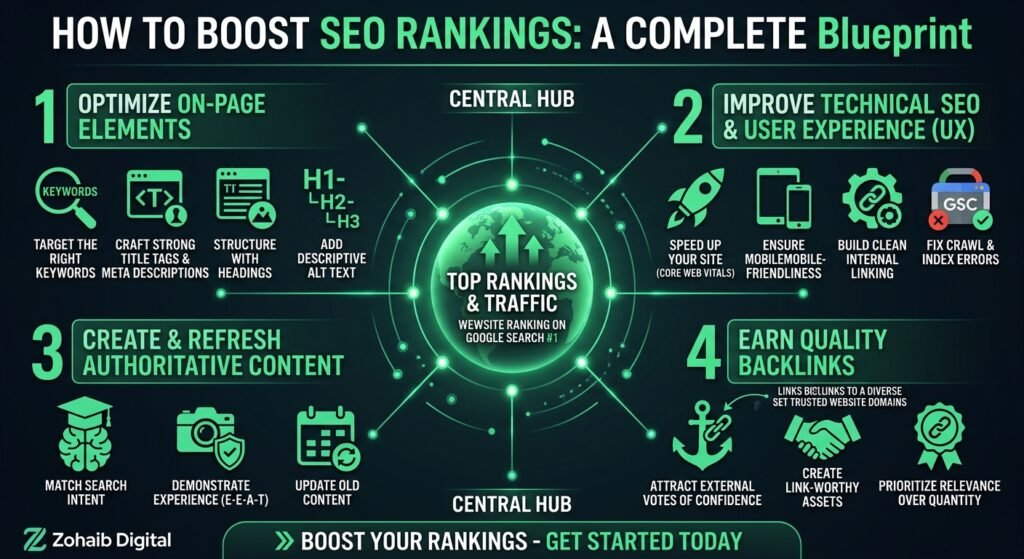
Quick Summary: Discovering how to boost seo rankings effectively requires a synchronized execution across four primary technical and creative pillars:
On-Page Optimization: Strategic focus keyword placement, search intent alignment, optimized title tags, meta descriptions, semantic content depth, clear header hierarchy (
H1–H4), and descriptive alt text.Technical SEO & User Experience (UX): Rapid loading speeds via Core Web Vitals, responsive mobile layouts, clean URL permalinks, crawl error resolution, and XML sitemap management.
Content Quality & E-E-A-T: Publishing original, helpful, and continuously refreshed content backed by real-world experience, expertise, authoritativeness, and trust (E-E-A-T).
Authority & Backlink Acquisition: Securing high-quality, topically relevant external
dofollowlinks from reputable domains to establish domain authority and trust.
Comparative Analysis: Traditional SEO vs. Modern AI Search Engine Optimization
To master how to boost seo rankings in today’s search landscape, you must understand how traditional optimization differs from modern AI-driven frameworks:
| Feature / Dimension | Traditional SEO Focus | Modern AI & Generative Search (AEO / GEO / AIO) |
| Primary Goal | Exact-match keyword density & direct clicks |
Direct answer resolution, intent fulfillment, and citation |
| Target Audience | Search engine crawlers & human skimmers | AI LLM summarizers, intent engines, and multi-modal searchers |
| Content Structure | Standard paragraphs & basic heading tags |
Direct answer blocks, bullet points, structured tables, & JSON-LD schema |
| Authority Signal | Anchor text distribution & sheer link volume |
E-E-A-T, entity context, brand citations, and topically authoritative links |
| Keyword Strategy | Fixed keyword counts & string-based matching | Semantic entities, LSI query coverage, and natural language fulfillment |
Pillar 1: Strategic On-Page Optimization & Intent Alignment
On-page optimization bridges the gap between what users search for and what search engines understand about your page. Knowing how to boost seo rankings begins with optimizing every on-page element for both human users and AI crawlers.
1.1 Intent-Driven Keyword Research & Semantic Keyword Integration
Understanding user search intent is critical. When learning how to boost seo rankings, your content must mirror the user’s explicit objective:
-
Target Search Intent Types:
-
Informational: Queries seeking knowledge (e.g., how to boost seo rankings, what is search intent).
-
Navigational: Queries seeking a specific site or login page (e.g., Google Search Console login, Semrush dashboard).
-
Commercial Investigation: Queries comparing solutions or service packages (e.g., best technical SEO audit package, WooCommerce vs Shopify for SEO).
-
Transactional: Queries ready to purchase or hire (e.g., hire SEO specialist, buy on-page SEO package).
-
+-------------------------------------------------------------------+
|                        KEYWORD INTENT MAPPING                     |
+-------------------------------------------------------------------+
| Informational      --> "How to boost SEO rankings step by step"  |
| Commercial         --> "Best technical SEO audit packages"        |
| Transactional      --> "Buy On-Page SEO Optimization Package"     |
+-------------------------------------------------------------------+
-
Long-Tail Target Keywords: Target low-competition, specific search queries that carry high commercial intent rather than relying purely on broad, hyper-competitive terms.
-
Semantic LSI Keyword Expansion: Integrate Latent Semantic Indexing (LSI) terms naturally throughout your text. For instance, alongside our target phrase, incorporate terms like boost website search visibility, improve Google keyword rankings, on-page SEO best practices, and search engine optimization starter guide.
-
Optimal Keyword Density Maintenance: Ensure your target focus keyword appears naturally across the document to maintain a healthy, readable keyword density (aiming between 1.0% and 1.5%) without triggering keyword stuffing penalties.
1.2 Title Tags, Meta Descriptions, & Permalink Optimization
Your title tag, meta description, and URL permalink serve as your digital display in search engine results. They directly impact your Click-Through Rate (CTR).
          [ OPTIMIZED SERP LISTING DISPLAY ]
-------------------------------------------------------------------
Title Tag:   How to Boost SEO Rankings: Step-by-Step Guide (2026)
URL Slug:    https://zohaibdigital.com/how-to-boost-seo-rankings
Description: Learn how to boost SEO rankings with proven on-page tactics,
             technical optimization, E-E-A-T content strategies, and
             authority backlinks.
-------------------------------------------------------------------
-
Title Tag Guidelines:
-
Keep titles under 60 characters (~600 pixels) to prevent truncation in Google Search results.
-
Place your primary target term (how to boost seo rankings) near the beginning of the title tag.
-
Add compelling modifiers (e.g., Step-by-Step Master Guide, Proven Blueprint) to drive clicks.
-
-
Meta Description Best Practices:
-
Maintain length between 140–160 characters.
-
Include a clear call-to-action (CTA) along with semantic secondary keywords.
-
Ensure every single page on your site has a distinct, non-duplicate meta description tag.
-
-
Clean Permalink Slug: Use short, descriptive permalinks containing your target keyword without filler words (e.g.,
/how-to-boost-seo-rankings).
1.3 Content Hierarchy & Subheading Structure (H1–H4)
A structured heading hierarchy allows search engine crawlers to extract topical context and helps human readers skim content quickly.
-
Single
H1Rule: Every article must contain exactly oneH1tag reserved for the primary article title. -
Logical Heading Cascade (
H2,H3,H4): Break long-form guides into structured sections using nested subheadings. -
Question-Based Subheadings: Incorporate natural language questions as subheadings to capture Google Featured Snippets and People Also Ask (PAA) boxes.
1.4 Image Optimization & Accessibility
Visual elements improve user engagement but can slow down page loading if unoptimized.
-
Descriptive Alt Text: Add clear, concise alt descriptions (under 125 characters) to all images, incorporating secondary keyword variations where naturally relevant.
-
Next-Gen File Formats: Convert standard JPEG or PNG files into next-generation WebP or AVIF formats to drastically reduce file payload size.
-
Image Compression: Compress images prior to uploading to ensure rapid rendering across mobile devices.
Pillar 2: Technical SEO & User Experience (UX) Mastery
Even the most thorough article will struggle to rank if technical hurdles block search engine bots from crawling, indexing, and rendering your site efficiently. To understand how to boost seo rankings, you must master technical SEO fundamentals.
2.1 Core Web Vitals & Performance Optimization
Google considers site speed and page experience explicit ranking signals. Maintaining fast page speed keeps users engaged and lowers bounce rates.
+--------------------------------------------------------------------+
|                    CORE WEB VITALS TARGET BENCHMARKS               |
+--------------------------------------------------------------------+
| Metric                            | Target Benchmark               |
+-----------------------------------+--------------------------------+
| Largest Contentful Paint (LCP)    | < 2.5 Seconds                  |
| Interaction to Next Paint (INP)   | < 200 Milliseconds             |
| Cumulative Layout Shift (CLS)     | < 0.1                          |
+--------------------------------------------------------------------+
-
Largest Contentful Paint (LCP): Measures perceptual loading speed. Optimize server response times and render-blocking resources to achieve an LCP under 2.5 seconds.
-
Interaction to Next Paint (INP): Measures visual responsiveness to user input. Minimize JavaScript execution times to maintain an INP under 200 milliseconds.
-
Cumulative Layout Shift (CLS): Measures visual layout stability during page load. Specify explicit image dimensions and avoid dynamic content injection to maintain a CLS score below 0.1.
2.2 Site Architecture & Internal Linking Strategy
A well-planned site architecture distributes link equity across your domain and guides search crawlers to your important commercial pages.
                 +--------------------------------+
                 |       PILLAR PAGE (HUB)        |
                 | "How to Boost SEO Rankings"    |
                 +---------------+----------------+
                                 |
        +------------------------+------------------------+
        |                                                 |
+-------v-------+                                 +-------v-------+
| INTERNAL LINK | <=============================> | INTERNAL LINK |
| Technical SEO |      Contextual Linking         | On-Page SEO   |
| Package       |                                 | Package       |
+---------------+                                 +---------------+
When implementing internal links within this guide, connect directly to targeted service solutions on your domain:
-
For technical health audits, review our detailed Technical SEO Audit & Fix Package to resolve crawlability and indexing bottlenecks.
-
For complete on-page content alignment, explore our dedicated On-Page SEO Optimization Package designed to maximize search intent and Rank Math performance.
-
For full store visibility, utilize our E-Commerce Growth & Optimization Package for WooCommerce catalog optimization.
-
For new site builds, leverage our Professional Business Website Package or WordPress Setup & Customization Package for an optimized, responsive foundation.
2.3 Crawlability, Indexation, & Schema Markup
Ensure search engine robots can crawl and parse your site’s technical structure without friction.
-
XML Sitemaps & Robots.txt: Maintain an up-to-date XML sitemap submitted directly in Google Search Console, ensuring your
robots.txtfile does not accidentally restrict important CSS or JS assets. -
Canonical Tags (
rel="canonical"): Prevent duplicate content issues by explicitly setting canonical URLs across all published pages. -
Structured Data (Schema Markup): Implement JSON-LD schema (e.g.,
TechArticle,FAQPage,BreadcrumbList,Organization) to help search engines understand content context and award rich snippet enhancements in search results.
Pillar 3: Content Excellence & E-E-A-T Framework
Creating high-performing content requires a commitment to quality, accuracy, and user satisfaction.
              +-----------------------------------+
              |          E-E-A-T TRIANGLE         |
              +-----------------------------------+
              |  EXPERIENCE  : Firsthand practice |
              |  EXPERTISE   : Subject knowledge  |
              |  AUTHORITY   : Industry trust     |
              |  TRUST       : Transparency/safety|
              +-----------------------------------+
3.1 Unpacking Experience, Expertise, Authoritativeness, & Trustworthiness (E-E-A-T)
Google relies heavily on E-E-A-T guidelines to evaluate content quality. When analyzing how to boost seo rankings, establishing authority is essential:
-
Demonstrate Firsthand Experience: Include original technical insights, hands-on audit workflows, or direct client growth metrics to prove hands-on expertise.
-
Highlight Subject Expertise: Feature verified author credentials detailing professional background in SEO engineering and WordPress development.
-
Build Site Trustworthiness: Maintain transparent site policies, security headers (HTTPS), direct contact details, and accurate citations to authoritative industry documentations.
3.2 External Authority References & DoFollow Link Integration
To reinforce content accuracy and topical trust, link out to established industry documentations using explicit dofollow external links:
-
Follow official webmaster practices directly from the Google Search Central Documentation to align with updated search standards.
-
Conduct competitive research and keyword tracking using industry-standard analytics tools detailed in the Semrush SEO Knowledge Base.
-
Explore foundational search principles and crawl guidelines outlined in the comprehensive Moz SEO Learning Center.
Pillar 4: Strategic Authority & Backlink Acquisition
Backlinks remain one of search engines’ primary trust signals, acting as digital votes of confidence. Learning how to boost seo rankings requires acquiring topically relevant external links.
4.1 Quality vs. Quantity Link Building
Not all external links carry equal value. Prioritize relevant, authoritative link profiles over volume:
-
Topical Relevance First: A single
dofollowbacklink from an established digital marketing publication holds far more weight than dozens of links from generic web directories. -
Authority Signals: Focus outreach on acquiring links from trusted industry portals, educational domains (
.edu), and recognized news organizations. -
Avoid Unnatural Link Schemes: Steer clear of link farms, automated web 2.0 networks, or low-quality paid links that violate search engine spam guidelines.
4.2 Sustainable Link Acquisition Tactics
Build lasting authority through natural link acquisition strategies:
-
Linkable Asset Creation: Publish original research, technical benchmarks, free tools, or downloadable checklists that industry peers naturally reference.
-
Digital PR & Expert Outreach: Contribute professional insights to industry publications and offer expert quotes for digital news roundups.
-
Broken Link Building: Identify broken outbound links on high-authority web pages and suggest your updated asset as a replacement.